Minimum Vital Logo
Minimum Vital
➡️ French Version  French Version
Thierry Payssan Eric Rebeyrol Charly Berna Jean-Luc Payssan
Minimum Vital

Minimum Vital

Progressive Rock since 1982
⬅️ back to introduction page
MonophonicMonophonicOrganOrganPianoPianoPolyphonicPolyphonicSamplerSampler

Samplers

We could say that the Mellotron is the first sampler in history. Indeed, the principle of a sampler is to record on a medium the note(s) produced by a real instrument, in order to be able to replay these recordings from a keyboard. In the case of the Mellotron, these are pieces of magnetic tape run through a reading head. And then, much later, came floppy disks, CDRs, hard drives, SD cards and all the other virtual media that we know today. This principle has made many musicians dream, including Peter Gabriel in particular, who knew how to use it creatively, with the expensive but legendary Fairlight. In the 90s, the sampler became democratized, and came in multiple devices, spearheaded by EMU for the Americans, and AKAI for the Japanese.

The appeal of the sampler comes from its ability to “swallow” everything, allowing the musician to control everything he wants (instruments, sound effects, etc.) with his fingers. This explains why it quickly invaded all of music, roughly between 1985 and 1995, going so far as to make acoustic drums disappear from studios. But as is often the case, by launching into a path too quickly, we don’t realize that it can lead to a dead end. Like many, I didn’t really see the main flaw of the sampler at first: it is ultimately only a “reproducer” of a sound image. An image always remains similar to itself, whatever we do.

Even if we integrate volume, filter, etc. parameters into the device, the “sampled” wave always remains identical. This is not what happens in the sound reality of a real instrument, where extremely complex vibratory phenomena are set in motion. The same piano key, for example, struck several times in a row with the same intensity, will never reproduce exactly the same sound. Indeed, the timbral and harmonic signature of the latter constantly undergoes subtle variations due to numerous acoustic and material parameters. Even an analog synthesizer never actually produces the same sound twice, with very small variations. And it turns out that the ear is capable, even unconsciously, of perceiving these variations. This is why we end up tiring of an overly intensive use of “samples” in music.

As a precursor, a musician like Keith Emerson had already perceived this problem at the beginning of the 70s: he had decreed that he did not like the Mellotron (which he actually never used) because according to him it only reproduced the “photograph” of a sound, and did not deserve as such the name of instrument… Despite everything, here, as far as I am concerned, are the devices that I use:

Samplers

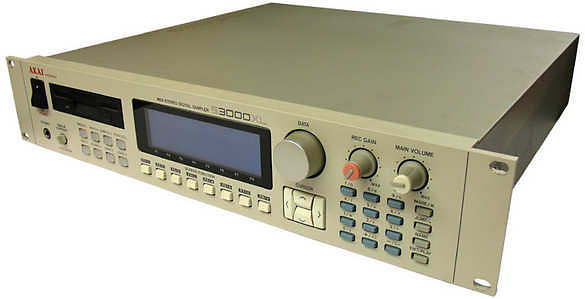
AKAI S2800 et S3000

Sampling within reach of (almost) everyone

The third generation of Akai samplers, the S2800 and S3000 series, represented the ultimate at the time.

They are true samplers, which impress with their ability to record anything, and can be used in multi-timbral mode. I used them a lot, and I still use the most souped-up version (the S3000), but I still have a bitter feeling about them: at the time (1994), the S2800 cost…

…more than 17,000 Francs (yes, you read that right)!

I had to take out a bank loan (the first in my life) to buy it. At that price, it only had 4 MegaBytes of memory, the additional memory sticks (4 maximum and very expensive) were optional, as was the coaxial input/output card for direct digital recording, and it didn’t even have a hard drive or CD-RW drive (just a floppy drive). On reflection, it was a scandalous scam!

Nowadays it’s worth nothing on the internet… and only a crazy person like me still uses it (but after all, I also use an Atari ST!).

Samplers

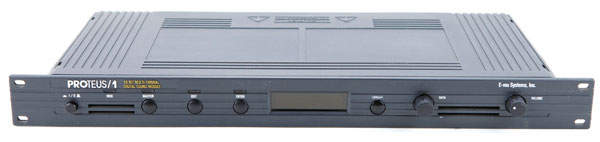
EMU Protheus 1

The American sound

The Proteus 1 is the first in a well-known series that has found its place in many studios. It is not strictly speaking a sampler, as it is closed (no recording or addition of sounds possible), but rather a multi-timbral sample player, from a well-stocked bank.

Due to the converters of the time, it has a very matte and very American color, with a marked midrange, which allows it to sit well in a mix.

I probably overused it, especially on La Source, in which it was used almost exclusively. At that time, I thought it could replace all my other equipment! It was a mistake, but in the first half of the 90s, the era was all about MIDI, with all the hardware controlled by the famous Cubase running on ATARI, and the sample was king. Anyway, I still use it in my home studio, because it has a rare quality, which many brands should be inspired by: its use is ultra simple and intuitive, and with it, there are never any bad surprises or headaches, which is already very appreciable!

Samplers

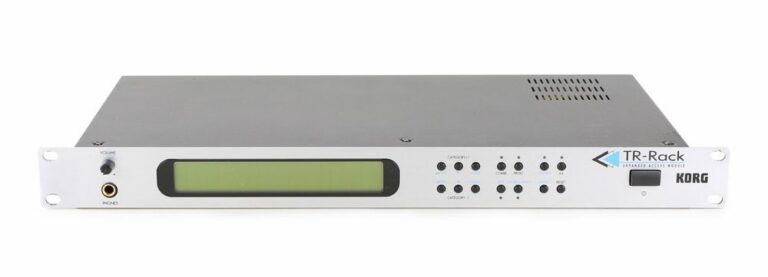
KORG TR Rack

KORG TR Rack et Thierry Payssan

The Swiss Army knife

The TR Rack is the Trinity’s expander, dating back to the late 90s. It’s also a sample player, but as memory storage capabilities have evolved, it’s much richer than the Proteus in terms of sounds and programs, making it a do-it-all device. It has some very beautiful strings, and superb church organ sounds.

I bought it in 1997 and use it constantly, both on stage and in the studio. However, when it comes to programming, it’s rather difficult to access, like many other things…

Samplers

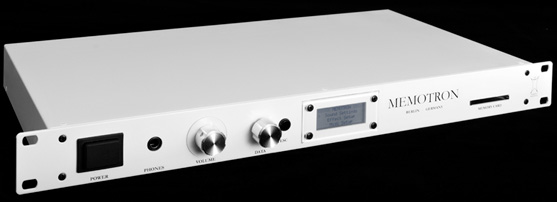
Manikin Memotron

Legend in box

The Mellotron may have been just a “sound image recorder” in Keith Emerson’s eyes, but it still has an undeniable personality!

What can be said that hasn’t already been said about the grain, the particular warmth of Mellotron sounds? The old-fashioned charm of its flute (Beatles), the grandeur of its choirs (Genesis), or the old-fashioned beauty of its strings (King Crimson)…

Well, some madman in Germany decided to design a digital version that would be as close as possible to the original instrument.

From around forty working Mellotrons, the artisanal company Manikin digitized the entire library of original sounds, and put them in a box, in the form of a keyboard the same size as the original, and an expander version (presented here).

I have the inestimable luck of owning this marvel, which was given to me by my brother Jean-Luc in 2013. The sound is a delight (and I doubt you can tell the difference from the original), with the added benefits of no repairs, no maintenance, and light weight. For the moment, I don’t use it on stage, and prefer to jealously guard it in my home studio. It should feature prominently on the next album.

MonophonicMonophonicOrganOrganPianoPianoPolyphonicPolyphonicSamplerSampler